
FOR

CONTEXT
As a designer and creative technologist, I was paired with an engineer to build and present a proof of concept that showcased how might robot could enhance the supply chain.
Brief
As part of our lab’s mission to integrate emerging technologies into supply chain solutions, I was approached by our director to join a tactical team tasked with developing a proof of concept using Softbank’s humanoid robot, Pepper, for an upcoming conference. With no predefined use cases, we had the autonomy to determine how our proof of concept could make an impact. We had three months to ideate, develop, and prepare for the showcase, including the opportunity to collaborate with the Pepper engineering team to ensure we could develop the concept independently.
Design approach
Fast tracking discovery
Given the unique nature of our mandate, we initiated the project directly in the prototyping phase, making early assumptions to drive our development. Although this approach deviates from traditional design best practices, it allowed us to quickly bring ideas to stakeholders for discussion and research, which was crucial under our tight timeline.
Identifying the Use Case
For our proof of concept to resonate, it needed to address relevant and thought-provoking challenges. Our initial task was to identify use cases where Pepper could excel, particularly within the realms of supply chains and retail.
Understanding Pepper’s Strengths
Through our evaluation, it became evident that Pepper was not suited for functional or industrial tasks, such as handling merchandise. Its humanoid form and relatively slow movement were clear indicators that its strength lay in engaging with humans on an emotional level, making it more appropriate as a customer service robot rather than an industrial one.No, they instead gave Pepper an humanoid shape and behavior in the hopes it would connect to humans on a more affective level. This cute robot is clearly destined at customer facing matters, this makes it more of a service robot.
Customer service: humans vs. robots
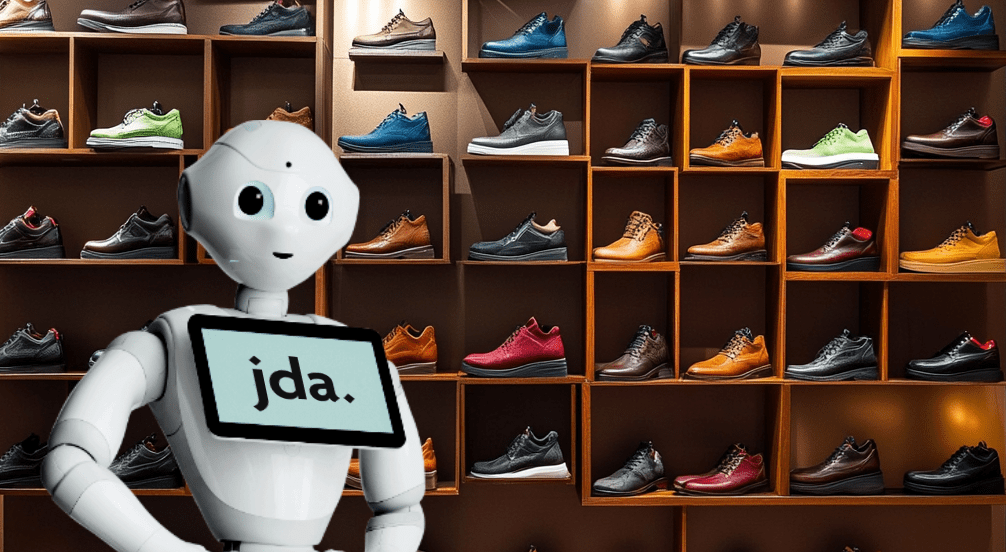
Our focus was on creating value—identifying tasks that Pepper could perform better than humans. We decided on positioning Pepper as a shoe store assistant, specifically addressing the “buying a pair of shoes” journey. In stores, employees often spend significant time checking inventory in the back, a task where humans are less efficient. Our concept aimed to elevate the role of the human employee to that of an advisor, while Pepper handled inventory checks.
Design concerns
Conversationally focused
We prioritized making interactions with Pepper as humanlike as possible. The chest-mounted tablet was used solely to visually support conversations, avoiding the pitfall of making Pepper a glorified tablet, which we had observed in other prototypes.
Context awareness
Understanding customer requests like “Do you have these in my size?” is challenging for a robot. The lack of modern sensors meant that Pepper’s primary method of identifying products was through awkwardly scanning QR codes, which was far from ideal.
Enhancing Pepper’s Capabilities
To overcome these limitations, we equipped Pepper with additional hardware—a Raspberry Pi acting as a web server, allowing us to integrate our choice of sensors and experiment with user interactions. This “Pepper’s backpack” significantly enhanced its abilities.
Shoe detection strategies
We experimented with various sensing technologies, ultimately showcasing RFID tags in our demo, with the tags embedded under the shoes and the reader on top of Pepper’s tablet. We also explored Bluetooth beacons, which allowed Pepper to identify the nearest product, making interactions feel almost magical. However, we had to introduce slight delays in Pepper’s responses to avoid an uncanny feeling from its near-instantaneous replies.
Demo
I was responsible for planning and implementing the conversational tree, developing the product sensors, designing and developing the tablet UI, and building the mobile app.
Behind the Scenes: Data Logging and Enhanced Customer Insights
Pepper was designed to log every interaction and outcome, with the option to record demographic information such as age and gender. This data collection fed into a broader narrative within our lab, where we believed that enhanced data collection throughout the customer journey in stores could significantly improve product planning accuracy. This added layer of intelligence transformed Pepper from a simple assistant to a powerful tool for gathering actionable insights.
Outcome
Lab visibility
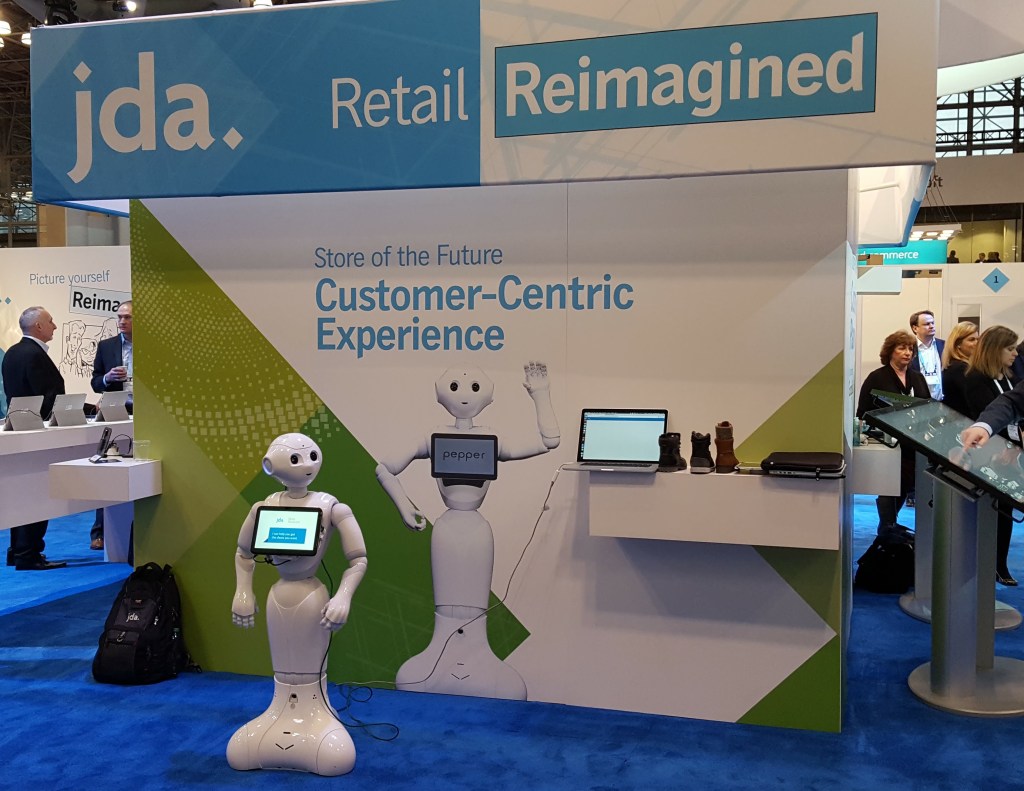
We presented our demo at over 10 conferences across North America and Europe, including a major retail conference where we shared the stage with Softbank Robotics.
Customer discussions and research
Our proof of concept sparked meaningful discussions with retailers about the future of retail and the challenges it faces. These insights were fed back into the lab’s research, influencing future directions in data collection in stores and omnichannel retail journeys.
Reflection on Pepper
Despite Pepper’s promise of humanlike interaction, the reality often fell short, leading to user frustration. While the robot’s novelty generates interest and discussions, its current capabilities suggest that a traditional self-service kiosk might be more practical in many cases. For a robot like Pepper to truly excel, improvements in context awareness and conversational skills are essential. Perhaps with the advancements in AI post-2020, more could have been achieved, but at the time, Pepper’s limitations were clear.
 Ben Rochon